


PlayPlus: Earn & Rewards
Creation Tech Pte. Ltd.
I approached PlayPlus: Earn & Rewards as an entertainment app rather than a conventional game. Its central idea is straightforward: you play games, try games, and receive rewards along the way. That makes it interesting for people who already enjoy experimenting with mobile titles, but it also creates a different expectation from opening a normal game. Here, the value is not only whether a particular game is fun; it is also whether the surrounding discovery and reward experience feels worthwhile.
Created by Creation Tech Pte. Ltd., PlayPlus sits in the entertainment category and is free to use. The app is aimed at a mature audience, with a 17+ content rating, so I would not treat it as a children’s gaming tool. Its store summary is compact, but the practical appeal is easy to understand: it gives casual players a reason to explore games they might otherwise ignore.
My first impression is that PlayPlus works best as a side activity. I would not install it expecting one deep, polished game to occupy me for weeks. I would install it when I want a rotating selection of things to try and like the idea of turning some of that spare-time play into rewards. The important distinction is that PlayPlus is a discovery-and-reward layer around gaming, not a replacement for a dedicated game library.
How PlayPlus feels in its current form
A simple concept with a different kind of motivation
Most mobile game stores ask me to choose a title based on screenshots, ratings, or a short description. PlayPlus adds another question: is this game worth trying as part of a reward journey? That changes how I browse. Instead of committing immediately to one download, I can approach the catalog with a testing mindset, sampling titles and deciding which ones deserve more of my time.
That approach is particularly useful for casual players who become bored with repeating the same game. A person waiting for a train, taking a short break, or looking for something new in the evening may appreciate having a reason to try unfamiliar games. The app can also suit players who enjoy comparing different styles, because the experience is less about building an identity around one title and more about moving through a selection.
Related News

Why WhatsApp Messenger Still Makes Everyday Communication Feel Easy

Jurassic World: The Game Is the Better Dino Tycoon for Strategic Players

Threads in Real Life: Who Should Join, Lurk, or Leave

How SHEIN Turned Shopping Into an Endless Content Feed

How to Make Fortnite Feel Smarter on Mobile

Should You Switch to Microsoft Outlook on Mobile?
There is a trade-off, though. Reward-focused play can make me evaluate a game too quickly. A title that needs patience may feel less attractive if I am thinking mainly about progress toward a benefit. Conversely, a simple game with an easy learning curve may become appealing because it fits short sessions. In other words, PlayPlus encourages efficiency, while traditional gaming often rewards immersion. Neither approach is automatically better, but they serve different moods.
Who is likely to get the most from it
I see the strongest fit for adults who already spend time on mobile games and want a more structured way to discover new ones. It may also appeal to people who dislike paying upfront just to test a game. Since PlayPlus itself is free, the barrier to trying the service is low, although I would still read each in-app condition carefully before investing significant time.
It is less suitable for someone seeking a single premium-quality experience, a story-driven adventure, or a competitive game with a stable long-term community. It is also not the right choice for anyone who dislikes reward systems on principle. If the act of tracking progress, meeting conditions, or checking whether an activity qualifies feels like work, the entertainment value may disappear quickly.
Gallery
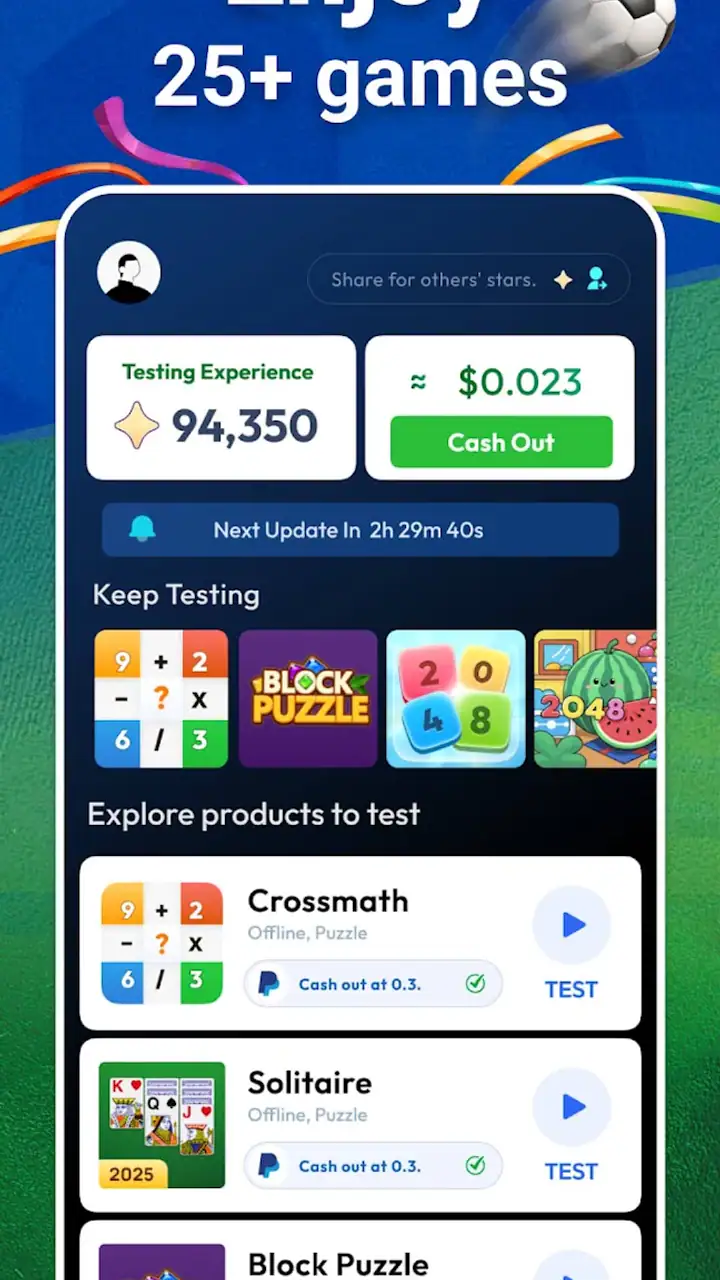
The mature age rating matters here. I would keep the app away from younger users and treat the rating as part of the decision, not as a minor label. Parents looking for a safe, simple game hub for children should choose an option designed and rated for that audience instead.
A realistic everyday use case
Imagine I have twenty minutes after dinner and want something lighter than a full gaming session. I open PlayPlus, browse what is available, and choose a game that looks easy to understand without a long tutorial. I play for a short period, then decide whether the experience is enjoyable enough to continue. On another day, I may return to the same title because I already know how it works and can make better use of a brief session.
This is where the app’s concept makes practical sense. It gives a small amount of free time a clear purpose, while reducing the effort involved in finding something new. The key is to treat any reward as an extra benefit rather than the only reason to play. If I enjoy the game itself, the arrangement feels positive. If I am forcing myself through an unpleasant title solely for the reward, the exchange may not feel worthwhile.
What the current version tells me
The current release is version 1.0.39, and the app was released on July 22, 2025. Those details place PlayPlus in a relatively early stage of its product life, so I would judge it as an evolving service rather than a finished platform with years of refinement behind it. The version number shows that the developer has already moved beyond the initial launch build, but it does not by itself tell me how extensive each change has been.
That distinction is important. A newer version can improve stability, presentation, or account flow without changing the basic experience. I would therefore focus on how smoothly the app handles the things I actually do: finding a game, understanding the activity, returning later, and checking reward progress. Those everyday steps matter more to me than a version label alone.
How the developer’s direction affects the experience
Creation Tech Pte. Ltd. is building PlayPlus around a loop that depends on both entertainment and follow-through. A normal game can succeed if its core mechanics are enjoyable. A reward app has a wider responsibility: it must make the available activities understandable, keep progress legible, and make the user feel that time spent in a game is being recognized correctly.
That creates a higher standard for clarity. If I am unsure what counts as progress, when an activity is complete, or how a reward is handled, even a fun game can become frustrating. The app’s long-term quality will depend not just on the number of games it presents, but on how confidently it guides me through the entire process.
What has changed, what still needs attention, and what I would watch
Reading the product’s evolution carefully
PlayPlus already has a sizeable public footprint, with more than 500 thousand installs and an average rating of 4.8 from roughly 24 thousand ratings. Those figures suggest that the concept has attracted meaningful interest and that many users have responded positively. They are encouraging signs, but they do not remove the need for personal testing. A high average can reflect strong satisfaction with the overall idea while individual experiences still vary depending on device, game choice, and expectations.
The presence of hundreds of written reviews also gives the app a more substantial feedback base than a brand-new experiment. I would use those comments to look for recurring themes rather than relying on one enthusiastic or negative opinion. In particular, I would pay attention to comments about reward clarity, reliability of progress, and how easy it is to understand the next step.
Because the app is free, the main cost is usually attention and time. That makes the quality of the instructions especially important. A small amount of confusion repeated across several sessions can matter more than a minor visual imperfection. My advice is to begin with a short trial: explore the interface, understand one activity, and only then decide whether PlayPlus deserves a regular place on the phone.
How existing users may experience the current release
For someone already using PlayPlus, version 1.0.39 should be viewed as the current baseline rather than a promise of a particular future direction. Existing users will probably care most about continuity. If they have already found games they enjoy, they want returning to those activities to feel predictable. If they use the app mainly to discover new titles, they will care more about whether browsing remains fresh and understandable.
I would also recommend keeping expectations realistic when moving between games. Each title can have its own pacing, controls, and learning curve. A user who treats every activity as a quick route to a reward may abandon games before discovering their appeal. A better workflow is to separate the first few minutes into two questions: do I understand what I am expected to do, and do I actually enjoy doing it? If the answer to the second question is no, continuing purely for the reward may be a poor use of time.
Another useful habit is to keep personal track of what I have started and why. Reward systems can encourage me to open several games at once, which makes the experience feel scattered. Choosing one or two activities for a session keeps the app from becoming a list of unfinished obligations. This is a small discipline, but it makes the entertainment side much stronger.
The friction that could limit its appeal
The biggest potential weakness is the tension between play and administration. The more attention I spend monitoring tasks, conditions, or progress, the less spontaneous the gaming feels. PlayPlus needs to make that information easy to understand without turning every session into a checklist. If the user has to remember too many details, the app risks feeling like a productivity tool disguised as entertainment.
There is also a quality-control challenge. A discovery platform is only as satisfying as the games it places in front of me. If the selection feels repetitive or if too many titles are poor matches for my interests, the reward concept will not be enough to keep me engaged. This is where PlayPlus differs from a standard app-store search: I am not only evaluating individual games, but also trusting the platform to make exploration worthwhile.
Another limitation is that reward-oriented users may have different priorities from serious gamers. A dedicated gamer may prefer better controls, deeper progression, or stronger social features, while a PlayPlus user may prefer quick access and clear completion steps. The app cannot perfectly optimize for both groups at once. I would choose it for variety and low-commitment experimentation, not as my main destination for high-end mobile gaming.
How it compares with ordinary alternatives
Compared with browsing the usual Android or iOS game store, PlayPlus offers a more directed reason to try something unfamiliar. A normal store is better when I already know the exact game I want, need extensive compatibility information, or want to compare a large number of established titles on my own. PlayPlus is more appealing when I want the discovery process to feel active and connected to rewards.
Compared with a subscription service, PlayPlus has a different value proposition. A subscription usually focuses on access to a curated library, while this app centers on trying games and earning through participation. Someone who wants a predictable catalog without reward mechanics may prefer the subscription route. Someone who enjoys sampling mobile games and does not want another recurring entertainment commitment may find PlayPlus more suitable.
Compared with ordinary free-to-play games, PlayPlus can make short sessions feel more purposeful, but it may also introduce extra mental overhead. A standalone game lets me focus entirely on its own loop. Here, I am balancing the quality of the game with the wider reward experience. That is a genuine advantage for curious casual players and a genuine disadvantage for anyone who wants a completely uninterrupted game.
Practical habits that improve the experience
I would start by exploring the app when I have enough time to read the activity details properly, rather than rushing through setup during a busy moment. Before playing, I would identify the exact action that matters for progress and decide how long I am willing to test the game. This prevents a short entertainment break from quietly becoming an open-ended commitment.
I would also judge rewards by the time and enjoyment involved, not by their existence alone. A reward is useful only if the route toward it feels reasonable. If a game is enjoyable, progress can be a pleasant bonus. If it is not enjoyable, I would stop instead of allowing the reward structure to dictate my free time.
Finally, I would keep the app updated through the normal store process and revisit my expectations after changes. Since PlayPlus is still in an early phase, future releases may refine how discovery, progress, or rewards are presented. I would look for clearer explanations, smoother transitions between activities, and fewer reasons to wonder whether an action has counted. Those improvements would do more for the app than simply adding more titles.
My recommendation for different kinds of users
I recommend PlayPlus to adults who like casual mobile games, enjoy trying unfamiliar titles, and see rewards as a pleasant addition to entertainment. Its free entry point and strong average rating make it reasonable to test, especially if the idea of a guided game-discovery experience appeals to you. I would approach it with a short-session mindset and keep the focus on games that I genuinely find enjoyable.
I would skip it if I want one carefully crafted game, dislike reward-based motivation, or expect every activity to offer the depth of a dedicated premium release. I would also choose a more conventional family-oriented option for younger players because of the mature age rating.
My overall view is positive but measured. PlayPlus has a clear niche: it turns casual game exploration into a more purposeful activity without charging for access to the app itself. Its future success will depend on whether it keeps that loop transparent and enjoyable as the product develops. For me, it is worth trying as a companion to normal mobile gaming, provided I remember the most useful rule: play because the activity is worth my time first, and treat the reward as the bonus rather than the obligation.
FAQs for PlayPlus: Earn & Rewards
What is PlayPlus: Earn & Rewards, and how does it work?
PlayPlus: Earn & Rewards is a rewards app that lets users collect points or credits by completing activities such as playing selected games, trying offers, watching content, or reaching specific milestones. After installing the app, you normally choose an available task, follow its instructions, and wait for the activity to be tracked before receiving the advertised reward. The exact tasks and earning rates may vary by country, device, and current promotions.
Is PlayPlus: Earn & Rewards free to download and use?
The application is generally presented as free to download, and users can usually begin completing available activities without paying an upfront subscription fee. However, some offers may lead to third-party apps, games, surveys, or services that have their own optional purchases or terms. Read each offer carefully before participating, avoid entering payment details unless you fully understand the conditions, and check whether your region has any restrictions or unavailable features.
How can rewards be redeemed in PlayPlus: Earn & Rewards?
Once you reach the required minimum balance, PlayPlus may allow you to exchange your earnings for supported rewards, such as gift cards, digital credits, or other payout options shown inside the app. Redemption methods, minimum thresholds, processing times, and availability can differ depending on location and account status. Before spending time on tasks, open the rewards or cash-out section to confirm which options are currently offered to you.
Why might my completed tasks or rewards not be credited?
Tracking problems can occur if an offer is opened outside the app, if the required installation or milestone is not completed exactly as described, or if tracking permissions, advertising settings, or network conditions interfere with verification. Some offers also require a new user who has never installed the promoted app before. Keep screenshots and confirmation details, allow the necessary permissions, and contact PlayPlus support through the app if a valid reward remains missing.
Is PlayPlus: Earn & Rewards safe, and what should I check before using it?
As with any rewards platform, safety depends on the information and permissions you provide as well as the third-party offers you choose to access. Review the app’s privacy policy, requested permissions, age requirements, and payout terms before creating an account. Avoid sharing sensitive information unnecessarily, be cautious of offers requesting payment or excessive personal data, and remember that rewards are not guaranteed income. Availability and reliability can also change over time.
Pros
- Multiple reward options
- including gift cards and other redeemable benefits.
- Simple task-based layout makes available earning opportunities easy to browse.
- Suitable for users who prefer short activities rather than long surveys.
- Progress and reward status can help users track completed activities.
- May offer occasional bonus campaigns that increase earning potential.
Cons
- Rewards and tasks may vary significantly by country or region.
- Some activities can provide very small returns for the time required.
- Availability of surveys and offers may change without notice.
- Certain rewards may have minimum redemption thresholds.
- The app may request personal or demographic information for eligibility.


